Moving to another country in retirement sounds straightforward until you start looking into the details. Visas, banking, healthcare, taxes, driving rules, household help, pets, internet; the list goes on.
It’s a lot to figure out, especially from abroad, and most of the information online is scattered, often outdated, and rarely written with retirees specifically in mind.
In this guide, we’ll pull it all together in one place. We’ll cover the practical steps in the order you’ll actually need them, with real 2026 numbers and honest answers to the questions that trip people up most.
There’s no hype here and no agenda. Just the information you need to move to Mexico the right way, starting with the most important step of all.
So, first things first, let’s talk about the Visas.
Visas and Legal Residency
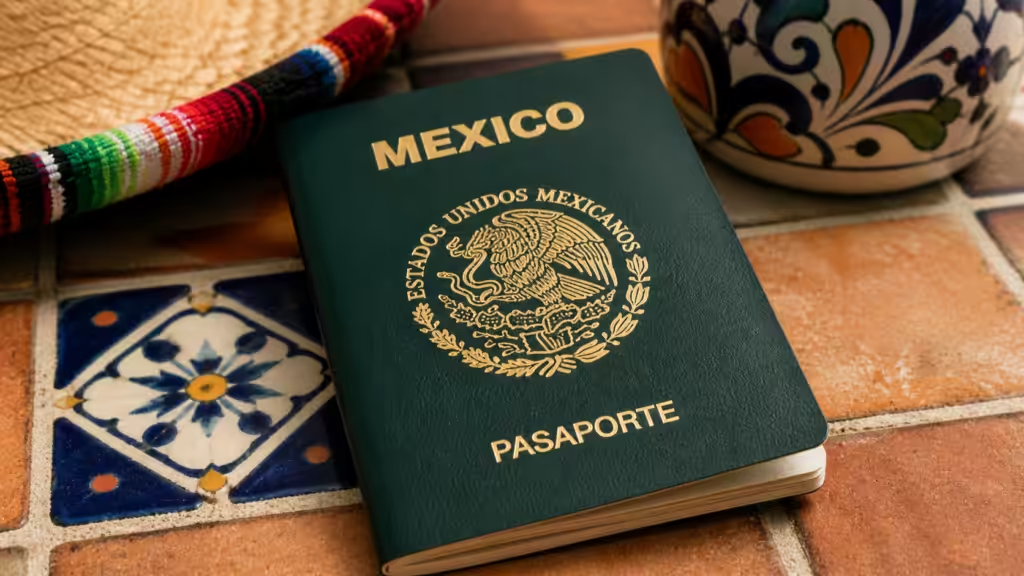
Mexico offers two residency pathways for retirees: temporary and permanent. The right choice depends on your financial situation and how long you plan to stay.
The process is orderly when you follow the correct sequence. It gets expensive and frustrating when you don’t.
What Is the Temporary Resident Visa?
The Temporary Resident Visa, known officially as Residente Temporal, is the most common starting point for American and Canadian retirees. It permits foreigners to legally reside in Mexico for up to four years, primarily for retirement, before potentially upgrading to permanent residency.
To qualify in 2026, you need to show a consistent monthly income of around $4,400 USD for the past six months, or savings of approximately $72,000 USD over the past 12 months. You need to prove one or the other, not both.
The Application Process
The application process starts at your nearest Mexican consulate in the US or Canada, not in Mexico. After your visa is approved and stamped in your passport, you enter Mexico and then have 30 days to exchange your visa sticker for a resident card at the nearest INM office.
That exchange process is called the canje, and missing the 30-day window is one of the most common and most avoidable mistakes retirees make, especially when arriving in the middle of a long move and assuming there’s time to settle in first.
After your first year, you can renew for an additional one, two, or three years at INM’s discretion, without needing to prove financial solvency again. After four consecutive years as a temporary resident, you can apply for permanent residency without leaving Mexico.
Permanent Residency Visa
To qualify for permanent residency directly in 2026, you need to demonstrate around $7,400 USD of monthly income or a total balance of around $300,000 USD in savings. Mexican consulates only issue permanent residency visas to people who are officially retired.
Permanent residency has no renewal requirement. Once granted, you’re in indefinitely. There’s also an unwritten expectation at most consulates that direct permanent residency applicants are at least 62 years old, though this varies by location.
What Does It Cost and What Are the Common Mistakes?
Government processing fees doubled in 2026, pushing the total cost for the full four-year journey from temporary to permanent residency from about $1,350 USD to over $2,700 USD per person.
Immigration advisors, who help with paperwork and appointments, typically charge between $200 and $500 USD per person per process and are worth considering if you’re navigating this for the first time.
Three mistakes come up repeatedly among retirees who struggle with the process.
- Entering Mexico as a tourist instead of on an approved visa.
- Missing the 30-day canje window after arrival.
- And not accounting for the fact that financial requirements and documentation standards vary between individual Mexican consulates, which means what worked for a friend who applied in Los Angeles may differ from what your consulate in Houston or Toronto requires.
Always verify requirements directly with the consulate where you plan to apply.
CURP and RFC
Two acronyms come up constantly in the Mexican paperwork process, CURP and RFC, and you need to know what these are before you arrive, because you’ll need both sooner than most people expect.
What Is the CURP?
The CURP, which stands for Clave Única de Registro de Población, is Mexico’s national identity number. Think of it as the equivalent of a Social Security Number, but used specifically for identity purposes rather than tax tracking.
Foreign residents are issued a CURP automatically when they receive their residency card. You don’t need to apply for it separately.
Once you’re settled in Mexico, you’ll use your CURP constantly. It’s required for IMSS healthcare enrollment, which matters most for retirees managing ongoing medical needs. It’s also required for opening a bank account, getting a Mexican driver’s license, and signing up for phone services.
The good news is that it never expires. The same number stays with you for life, even when your residency card needs renewal.
One update worth knowing: as of early 2026, Mexico introduced a new Biometric CURP, a physical plastic card that includes fingerprints, facial photograph, iris scan, and digital signature.
The traditional paper CURP is gradually being phased out for official procedures, including banking, property transactions, and immigration renewals. If you’re arriving in 2026, ask about the biometric version when you complete your INM canje.
What Is the RFC?
The RFC, which stands for Registro Federal de Contribuyentes, is Mexico’s tax identification number. It’s issued by SAT, Mexico’s tax authority, and tracks taxable activity, including income, property transactions, and certain banking activity that retirees encounter once they settle in.
Most retirees who live simply in Mexico, renting a home and drawing on foreign income, don’t strictly need an RFC right away.
That said, banks now commonly ask for an RFC when you open an account, and if you own property in Mexico, you’ll need one to claim capital gains tax deductions when you or your heirs eventually sell.
One thing to keep in mind, though.
The RFC isn’t issued automatically like the CURP. You apply for it separately at a SAT office after receiving your residency, and you must have your CURP in hand before you can complete the RFC registration.
The process can be done in person or partially online, though setting up an electronic signature for future tax changes requires an in-person visit. Many retirees use a local accountant to handle it, which keeps the process simple and avoids the language barrier at the SAT office.
Banking and Moving Money
Managing money across borders is one of the most practical day-to-day concerns for retirees in Mexico, and the landscape shifted significantly in 2025 and 2026. So, let’s start by asking the obvious question.
Do You Need a Mexican Bank Account?

A Mexican bank account isn’t strictly required to live in Mexico. Plenty of retirees manage entirely with their US or Canadian accounts, having Social Security or pension payments deposited at home and withdrawing pesos from ATMs as needed.
That said, a local account simplifies paying rent, utilities, and monthly facility fees, and reduces ATM fees that add up quickly over time.
The banking landscape for expats shifted significantly in June 2025 when the US Treasury designated Intercam Banco as a money laundering concern. The Mexican bank was subsequently acquired and restructured by Kapital, a fintech-backed group, with the rebrand formalized in late 2025. The transition disrupted what had been the most popular banking option for foreign residents in Mexico, and many expats who held Intercam accounts have since migrated to other institutions while Kapital establishes its expat-facing services.
Accordingly, most retirees now need a temporary residency card and an RFC to open a proper account at a mainstream Mexican bank.
Have a look at the current available options:
- Inbursa stands out for paying interest on account balances and operating seven days a week.
- Scotiabank wins on English-language accessibility.
- HSBC offers global integration.
- Banorte has the best mobile app.
Note that all four require your residency card, RFC, CURP, passport, and proof of address in Mexico. Bring originals and copies of everything.
How Do Most Retirees Move Money?
Wise remains the gold standard for US-to-Mexico transfers in 2026, offering rates close to mid-market with transparent fees. One limitation: Wise paused outbound MXN transfers in late 2025, so you can send money to Mexico, but you cannot currently send pesos back out through Wise.
We also have ARQ, formerly known as DolarApp and rebranded in March 2026, which is the more versatile option for expats because it transfers in both directions at a flat $3 USD fee per transaction.
It gives you both a Mexican CLABE number and US account details, so you can receive payments from either country.
What About ATMs?
ATM withdrawals remain common for smaller, day-to-day amounts. However, keep in mind that deposits over $15,000 USD equivalent trigger automatic SAT reporting.
This doesn’t mean you’ll be taxed, but expect documentation questions if you can’t explain the source of the funds.
Bank wires work for large one-time transfers but carry fees of $25 to $50 USD per transaction and slower processing times. Western Union and similar services are convenient for cash pickup but carry higher fees relative to the amounts transferred.
The most practical setup for most retirees is keeping their home country accounts active for Social Security or pension deposits, using ARQ or Wise for monthly transfers into Mexico, and opening a local Mexican account for rent, utilities, and any recurring care or facility fees once residency is in place.
Cost of Living Breakdown
The cost of living question is the one most retirees spend the most time researching, and most of what they find online is either outdated, oversimplified, or built around a lifestyle that doesn’t match their own. We’ll break it down by actual scenario with real 2026 numbers.
What Does a Realistic Monthly Budget Look Like?
A single retiree can live comfortably in Mexico on $1,500 to $2,000 USD per month. A couple typically needs $2,000 to $2,500 USD for a comfortable lifestyle that covers rent, utilities, groceries, healthcare, and entertainment without financial stress.
Those numbers hold in mid-range cities. In more expensive destinations like Los Cabos, Puerto Vallarta, or Playa del Carmen, add 20% to 30%. In more affordable cities like Merida, Oaxaca, or Chihuahua, subtract a similar amount.
Here’s what a realistic monthly budget looks like by scenario:
| Scenario | Monthly Cost (USD) | What’s Covered |
| Single retiree, simple lifestyle | $1,200 to $1,800 | Rent, groceries, utilities, local transport, basic healthcare |
| Couple, comfortable lifestyle | $2,000 to $2,500 | Rent, groceries, dining out, utilities, healthcare, entertainment |
| Couple, higher comfort | $3,000 to $3,500 | Above plus housekeeper, car, private health insurance, travel |
| Senior in assisted living facility | $1,500 to $2,500 | All-inclusive facility fee, personal care, meals |
| Senior in nursing home, private room | $2,500 to $3,000 | Full care, 24/7 supervision, meals |
As you can see, rent is the largest variable. A comfortable one-bedroom apartment in a popular expat area runs $500 to $800 USD per month. A two-bedroom house or apartment ranges from $700 to $1,200 USD.
Utilities for a couple in a two-bedroom home typically fall between $100 and $180 USD per month, with electricity spiking in hot months due to air conditioning.
Groceries for a couple who primarily cook at home run $350 to $500 USD per month. A three-course dinner for two at a good restaurant typically costs $40 to $60 USD.
For retirees who prefer eating out a few times a week instead of cooking, this is one of the lifestyle upgrades Mexico makes affordable.
What Do People Forget to Budget For?
The monthly rent or facility fee is the number most people plan around, and it’s only part of the picture. Health insurance premiums, which vary significantly by age and coverage level, rarely appear in the rosy budget estimates you’ll find on expat blogs.
One-time setup costs, including immigration fees, furniture, deposits, and the first month’s rent, can add $3,000 to $5,000 USD to your initial outlay. Budget approximately $12,000 MXN, roughly $650 USD, just for immigration office fees when you arrive to exchange your visa for a resident card.
You also shouldn’t forget the cost of hosting family. Most retirees in Mexico see their children and grandchildren visit once or twice a year, and some retirement communities even include guest suites or coordinate nearby short-term rentals to make these stays easier. If you’re renting privately, a slightly larger apartment with a guest room can be worth the extra monthly cost.
One more variable worth planning for: the Mexican peso has appreciated significantly, which makes Mexico more expensive in USD terms than it was a few years ago.
Many facilities and landlords quote in USD rather than pesos, which removes the currency risk, but it’s worth asking the question upfront before committing to a monthly cost.
Owning or Driving a Vehicle
The vehicle question comes up early for most retirees, and the answer depends almost entirely on which city you choose and what your day-to-day life looks like.

Do You Actually Need a Car?
In walkable cities like Merida, Oaxaca, and Mexico City’s central neighborhoods, most retirees get by without a car entirely.
Public bus fares run 50 to 60 cents per ride. Taxis and ride-hailing services like Uber and DiDi typically charge $2 to $5 USD for most in-city trips.
Maintaining a car, including fuel and insurance, averages around $170 USD per month, compared to less than $40 USD for public transport. In more spread-out coastal cities like Mazatlan or Los Cabos, having a vehicle makes daily life considerably easier.
Many retirees eventually stop driving altogether and rely on Uber, DiDi, or a regular hired driver, which in most expat cities runs around $15 to $25 USD for half a day.
What Are the License and Insurance Rules?
A valid US or Canadian driver’s license is generally accepted in Mexico for the duration of your permitted stay as a tourist. Long-term residents, however, should expect local licensing requirements to matter more over time.
Getting a Mexican driver’s license requires your CURP, proof of residency, and a visit to your local transit office. The process is straightforward and done entirely in Spanish, so many retirees use a local facilitator to handle it.
Mexican law doesn’t recognize foreign auto insurance as valid proof of financial responsibility. A Mexico-issued auto insurance policy is required to drive legally, regardless of what coverage you carry from home.
Yes, this can be a bit annoying.
However, Mexican auto insurance is inexpensive relative to US rates and can be purchased online before you cross the border or through local brokers once you arrive.
Important note: As of January 1, 2026, Mexico closed the regularization program that previously allowed permanent residents to keep foreign-plated vehicles in the country.
Permanent residents now need to either import their vehicle formally or acquire a Mexican-plated vehicle. Temporary residents can still bring a foreign-plated vehicle under a Temporary Import Permit, tied to their residency status.
Hiring Household Help or In-Home Caregivers
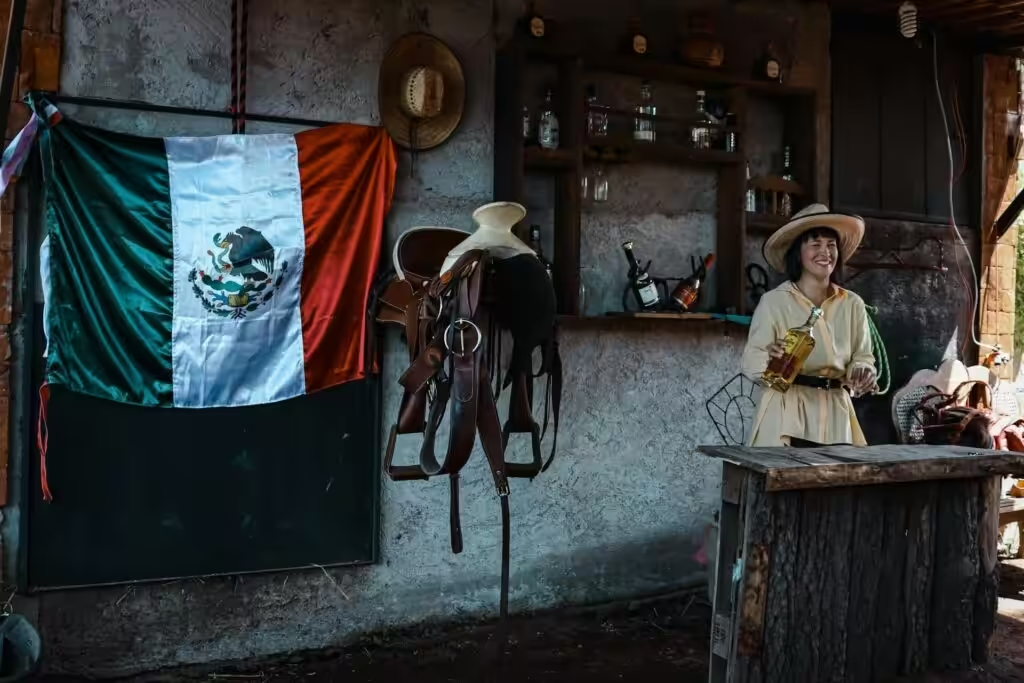
For retirees who want or need in-home support, this is one of the most meaningful cost differences between Mexico and the US or Canada. One of the more pleasant discoveries retirees make after settling in Mexico is how affordable household help actually is.
A housekeeper, gardener, driver, or in-home caregiver costs a fraction of what the same services would run in the US or Canada, and the availability of skilled, reliable help in most expat cities is genuinely good.
What Does It Actually Cost?
Rates depend on the type of help and their skills.
- A caregiver who can assist older adults and administer medication is more expensive than someone who does regular housework. A caregiver with nursing skills typically runs around $100 pesos per hour, roughly $5.50 USD.
- Full-time live-in caregivers and nurses cost between $500 and $1,500 USD per month, depending on their qualifications and duties.
- A part-time housekeeper coming two or three days per week generally runs $30 to $60 USD per visit in most expat cities.
In cities with large expat communities like Guadalajara, Merida, and Cancun, English-speaking caregivers are easier to find and typically charge a premium for it.
In smaller towns, most household help won’t speak English, which makes basic Spanish, or at least a willingness to use Google Translate, genuinely useful.
What Are the Legal Obligations?
This is the part most retirees skip over, and it creates real problems down the road. In Mexico, a formal employment relationship begins the moment the work starts, regardless of whether anything was signed. Verbal contracts are legally binding.
Mexican labor law heavily favors the employee, and failure to meet obligations can result in serious legal and financial consequences.
Recent legislation now makes IMSS enrollment mandatory for domestic workers, granting them access to healthcare, sick leave, and workers’ compensation.
Beyond IMSS, employers are required to pay an annual Christmas bonus called the Aguinaldo, equivalent to at least 15 days of the worker’s daily rate, as well as accrued vacation pay.
Many retirees use a local accountant to calculate these amounts correctly and keep clean records from the start.
The practical advice from retirees who’ve been through it is consistent: get recommendations from trusted sources in local expat groups, do a proper reference check for anyone providing care to an older adult, keep clear written records, and don’t treat household employment as an informal cash arrangement. It’s legal employment in Mexico, and the rules apply.
Pets

For many retirees, a beloved pet is one of the reasons the move feels possible at all. Pets are constant companions in later life, and leaving one behind is rarely an option worth considering.
The good news is that Mexico is genuinely pet-friendly, and the process of bringing a dog or cat from the US or Canada is far simpler than most people expect. The paperwork is minimal, the border crossing is brief, and veterinary care across the country is affordable and widely available.
Mexico no longer requires a health certificate for dogs and cats entering from the US or Canada. Your pet will be inspected by SENASICA, Mexico’s animal health authority, upon arrival. The inspection is brief and mostly visual.
As long as your pet is current on its rabies vaccination and has been treated for parasites within the last six months, the process is straightforward.
You’re allowed two pets per person entering duty-free. Additional pets may require a modest SENASICA fee of approximately 1,620 pesos. For couples, that means up to four animals without any extra paperwork.
For retirees moving into senior living facilities, it’s worth confirming the facility’s pet policy before you arrive. Most retirement communities in Mexico are pet-friendly, but rules on size, number, and care responsibility vary.
What About Vet Care Once You’re There?
Vet clinics are plentiful across Mexico, including in smaller towns. Fees are a fraction of what US clinics charge, and most common medications are inexpensive and widely stocked.
Major chains like Petco and Petsy operate in larger cities, and independent clinics are easy to find in all the main expat hubs, including Merida, Queretaro, and Monterrey.
Be careful, though. Coastal areas like Puerto Vallarta, Playa del Carmen, and La Paz carry a higher risk of heartworm.
A monthly preventive medication prescribed by your vet at home before you depart handles it completely, but it’s worth sorting out in advance rather than after the fact.
Internet, Cell Coverage, and Staying Connected

Staying connected in Mexico is genuinely easy in the cities where most retirees settle, and the infrastructure has improved significantly in recent years.
The gap between major cities and smaller towns is real, though, and worth understanding before you commit to a location.
What Is the Internet Like?
Median fixed broadband download speeds in Mexico have surpassed 90 Mbps nationwide, with full fiber deployment expanding quickly through providers like Totalplay, Megacable, and an upgraded Telmex network.
In practical terms, that means reliable video calls with family back home, streaming, and telehealth appointments are all manageable in any major expat city
In Mexico City, Guadalajara, and Monterrey, fiber connections hitting 100 to 200 Mbps are standard, more than enough for daily video calls with grandchildren or virtual appointments with US-based doctors.
Home internet plans typically cost between $25 and $40 USD per month. Outside major cities, speeds drop and reliability becomes less predictable.
In beach towns and smaller colonial cities, most apartments have workable internet, but testing the connection before signing a lease is worth doing.
Which Cell Provider Should You Use?
Telcel has the best overall coverage in Mexico, reaching 92% of the population with 4G LTE. Telcel and AT&T Mexico have the fastest speeds at around 20 to 50 Mbps on average, with 5G now live in major metropolitan areas.
Telcel continues to lead in reliability, scoring significantly ahead of its nearest competitor according to independent network testing.
Most retirees pick up a local Telcel SIM card shortly after arriving. Plans are prepaid or monthly, prices are low compared to US carriers, and registration requires only a passport. The process takes about 10 minutes at any Telcel store or large supermarket.
A practical setup for most retirees is a local Telcel SIM for day-to-day calls and data, combined with a home fiber or cable internet plan for streaming and video calls.
Many retirees also keep a US or Canadian number active through Google Voice or a similar service for calls back home, which costs very little and eliminates international roaming charges entirely.
How RetireMexico Can Help

The logistics of moving to Mexico are manageable, but they involve more moving parts than most people anticipate.
Getting the visa sequencing right, understanding the banking landscape, knowing which cities offer the infrastructure you need, and finding trustworthy household help all take time and local knowledge that’s hard to gather from abroad.
RetireMexico covers practical relocation information across all 20 cities we serve, with honest detail on costs, healthcare access, expat infrastructure, and senior care availability. The goal is to give you a realistic picture of what life actually looks like in each location before you commit to anything.
Retirees who want more personalized guidance can reach our team through the free guidance service. There’s no pressure and no pitch. Just a straightforward conversation about what you’re looking for, what your situation requires, and where in Mexico it’s most available.