You’ve heard the horror stories about healthcare abroad. You’ve also heard that Mexico has world-class private hospitals at a fraction of US prices. As usual, the truth sits somewhere between the two extremes, and it’s more nuanced than either side lets on.
The short answer is: Mexico’s healthcare system offers genuine quality at genuinely affordable prices, but it works differently from what Americans and Canadians are used to.
Knowing how it works before you arrive is the difference between going through it confidently and getting caught off guard when it matters most.
This guide covers everything you need to know, without the hype.
Finding and Verifying Qualified Doctors
Mexican doctors follow a structured licensing system that’s verifiable through public records, which means you can check credentials before choosing a provider.
Medical school in Mexico is a six-year program that combines undergraduate pre-med courses with medical training in a single degree. After graduation, doctors complete a mandatory year of social service in underserved communities before they can practice independently. Specialization requires two to five additional years of residency training. Many Mexican specialists complete part or all of their training in the United States, Canada, or Europe, which is why English-speaking doctors with international credentials are common in major expat cities.
Every doctor practicing in Mexico should have a Cédula Profesional, Mexico’s government-issued professional license. It’s issued by the Secretaría de Educación Pública (SEP) after verifying that the doctor completed an accredited medical program. The Cédula is public information, and you can verify any doctor’s credentials online at cedulaprofesional.sep.gob.mx by searching their name or license number.
Specialists hold a second credential called a Cédula de Especialidad, which confirms they completed an accredited residency in that field. A doctor can legally practice general medicine with only a basic Cédula, but cannot present themselves as a specialist without the specialty credential.
Ask to see both credentials before committing to a provider. Reputable doctors display them in their offices or provide them upon request without hesitation.
How Do You Find English-Speaking Doctors?

In large expat hubs such as Mexico City, Guadalajara, and Merida, English-speaking doctors are common in private hospitals. Outside major cities, language access decreases, which is worth factoring into your location decision if medical communication matters to you.
A practical tool for finding English-speaking doctors before you move is Doctoralia.com.mx.
The site lets you search by specialty, location, and language spoken, and many doctors offer telemedicine consultations, which means you can establish a relationship with a local provider before you even arrive.
You might also want to consider checking expat Facebook groups in your target city, as they are another reliable source for personal recommendations, since online reviews from people with similar needs tend to be more useful than general listings.
Private Care and Out-of-Pocket Costs
Healthcare in Mexico surprises most retirees the moment they see their first bill. A private specialist consultation that would cost $300 to $600 USD in the US runs $35 to $60 USD at a private hospital in Mexico.
Private hospitals in major cities like Guadalajara, Monterrey, and Merida offer modern facilities, up-to-date equipment, and specialists who have trained internationally. Internationally recognized private hospital networks like Hospital Angeles and Hospital Joya operate modern facilities across major expat hubs in Mexico.
Many retirees in these cities pay entirely out of pocket for routine care and still spend a fraction of what they’d pay back home.
For minor issues like infections, prescription renewals, or routine matters, many retirees use pharmacy doctors, where a general doctor can see you for $5 to $10 USD. For anything more serious, a consultation with a specialist at a private hospital costs $35 to $120 USD, compared to $150 to $350 back home.
What Is a Pharmacy Doctor?
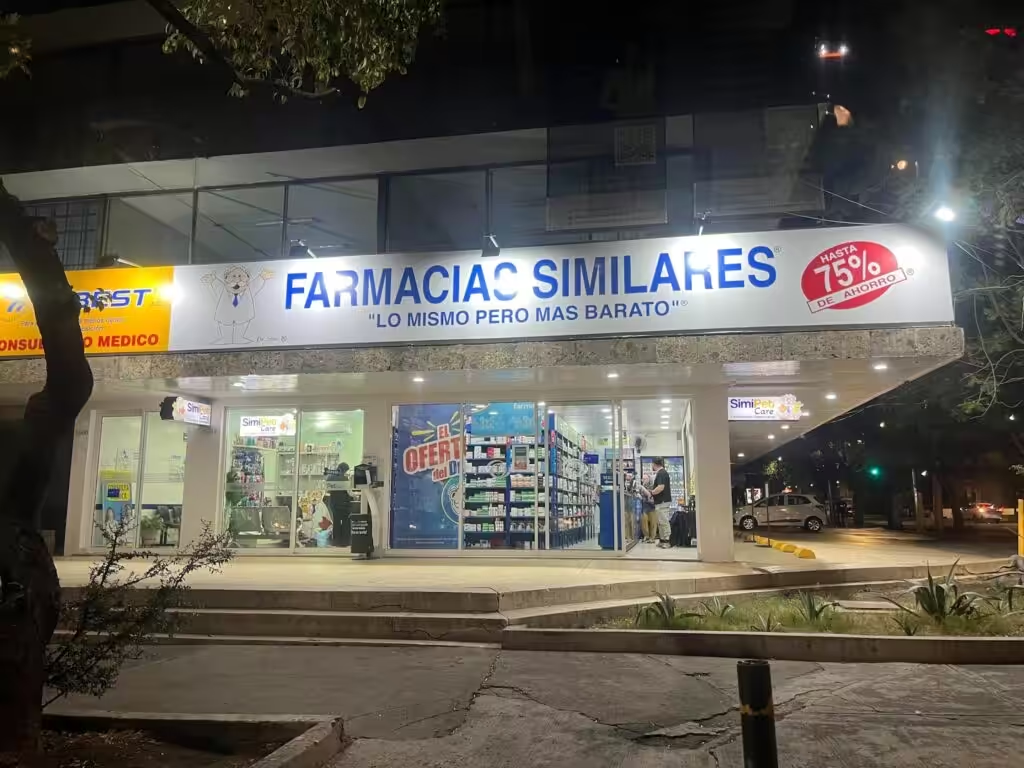
This is one of the most useful things to know about daily life in Mexico, and for some reason, most guides skip over it entirely.
Many pharmacies have consultorios, small consulting rooms attached to the pharmacy where a doctor can see you, write a prescription, and handle minor issues for as little as $5 to $10 USD.
Of course, there aren’t emergency rooms, but they handle routine things like infections, minor injuries, referrals, and prescription renewals.
The farmacia doctor is often the fastest and most affordable first step for retirees who need a quick consultation without booking a specialist appointment. Most expats use them regularly for routine matters.
Prescription Drugs in Mexico
Mexican pharmacies are one of the genuine quality-of-life upgrades that retirees discover quickly after arriving. They’re everywhere, they’re open late, and they operate very differently from pharmacies back home.
Most medications are available in Mexico, and the majority of them don’t require a prescription from a physician.
The exceptions include controlled substances like narcotics and anxiolytics such as Valium or Xanax, and antibiotics, which do require a prescription. This is great news for retirees managing chronic conditions with long-term medications, as such accessibility is a meaningful convenience.
And speaking of convenience, Farmacia Doctors are also there to help.
What About Prescription Drugs and Cost?
Prescription drugs manufactured in Mexico are 30% to 60% less expensive than the same medications made in the US.
Even most prescription drugs imported from the US cost less in Mexico. This is exceptionally useful for retirees on fixed incomes managing multiple medications, as that difference adds up significantly over the course of a year.
One important caveat: if you take controlled substances regularly, bring an adequate supply from home and sort out the Mexican prescription process before you run out.
At a pharmacy, the process for filling prescriptions for controlled substances is more involved than for standard medications. If you have a prescription for a controlled substance, the pharmacy will require you to present an ID to verify your identity as the patient. You may also be asked to sign the receipt and possibly provide a phone number as part of the process.
Health Insurance Options for Retirees
Private health insurance is where most retirees spend the most time comparing options, and for good reason. The right plan can make a major medical event manageable. The wrong one, or no plan at all, can wipe out savings faster than most people anticipate.
The good news is that healthcare services in Mexico are significantly more affordable than in the US or Canada, which means even a modest plan provides meaningful protection.
For example, a 60-year-old, a private Mexican insurance plan typically runs $150 to $300 USD per month. As for those over 70, premiums generally fall between $250 and $450 USD per month.
Those numbers are considerably lower than comparable coverage in the US, though age-based premiums do rise, so locking in a plan sooner rather than later makes financial sense.
What Are the Main Options?
Retirees in Mexico generally choose from three main routes, and many end up combining more than one.
The first is a Mexican private health insurance plan, known locally as a Gastos Médicos Mayores, or GMM plan. These plans are structured around deductibles, co-insurance, and annual coverage limits.
They don’t cover routine care, so you still pay out of pocket for GP visits, specialist consultations, medications, dental, and vision. What they do cover is catastrophic events, which is where the real financial risk lies. Major providers include GNP, AXA, MetLife, MAPFRE, and Allianz.
The second option is an international expat health plan, which tends to offer broader coverage across multiple countries. Major providers in this category include Cigna Global, IMG Global, GeoBlue, and Bupa Global.
These plans work well for retirees who split time between Mexico and the US or Canada, but premiums are higher, and the value depends on how much cross-border coverage you actually need.
The third is IMSS voluntary enrollment, Mexico’s public healthcare system, which deserves its own section entirely.
What Is IMSS, and Who Qualifies?
IMSS, the Mexican Social Security Institute, is Mexico’s public healthcare system. It covers government employees and private sector workers automatically through payroll, but legal residents can also enroll voluntarily.
Enrollment costs approximately $400 to $700 USD per person per year, depending on age, and covers the enrollee and their immediate family members.
In theory, IMSS coverage is comprehensive. It includes general medicine, specialist consultations, hospitalization, surgery, maternity care, mental health care, basic dental, and preventive services.
In practice, the experience varies significantly depending on where you live. In major cities, IMSS facilities are generally well-equipped and staffed. In rural areas and smaller towns, wait times can be long, and access to specialized care is more limited.
There’s more.
IMSS also applies waiting periods and may exclude some pre-existing conditions for voluntary enrollees. In some cases, it can decline an application altogether.
The enrollment process happens entirely in Spanish at your local IMSS office and requires your resident visa, proof of address, CURP number, and passport. Many retirees use a local immigration advisor or relocation service to navigate it.
The most common approach among retirees is a hybrid model: enroll in IMSS as a financial backstop for major hospitalization, continue using private care for routine needs at $35 to $120 per visit, and budget a total annual healthcare spend of $2,000 to $4,000 USD for a reasonably healthy person in their 60s.
That combination tends to offer the best balance of cost and coverage for long-term residents.
Medicare Abroad
Unfortunately, Medicare does not cover care outside the United States in most circumstances.
That doesn’t mean you should cancel it. Most financial advisors who work with expats recommend maintaining Medicare Parts A and B by continuing to pay the premiums even while living abroad, because gaps in Medicare enrollment trigger permanent premium penalties when you re-enroll later.
In other words, keep it active, but don’t count on it for day-to-day care in Mexico.
What About Medicare Advantage?
Medicare Advantage plans, also known as Part C, are a different story. Some of them do include international coverage, and this is where retirees in expat-heavy areas have found a workable solution.
In the Lake Chapala area, for example, Lakeside Medical Group has built its practice around coordinating care for residents who hold specific Medicare Advantage plans that include international benefits.
It’s not a universal solution. Coverage depends entirely on your specific plan, and not all Medicare Advantage providers extend benefits abroad.
Still, it’s worth reviewing your plan documents carefully or calling your provider directly before assuming you have no coverage at all.
Dental and Vision Care
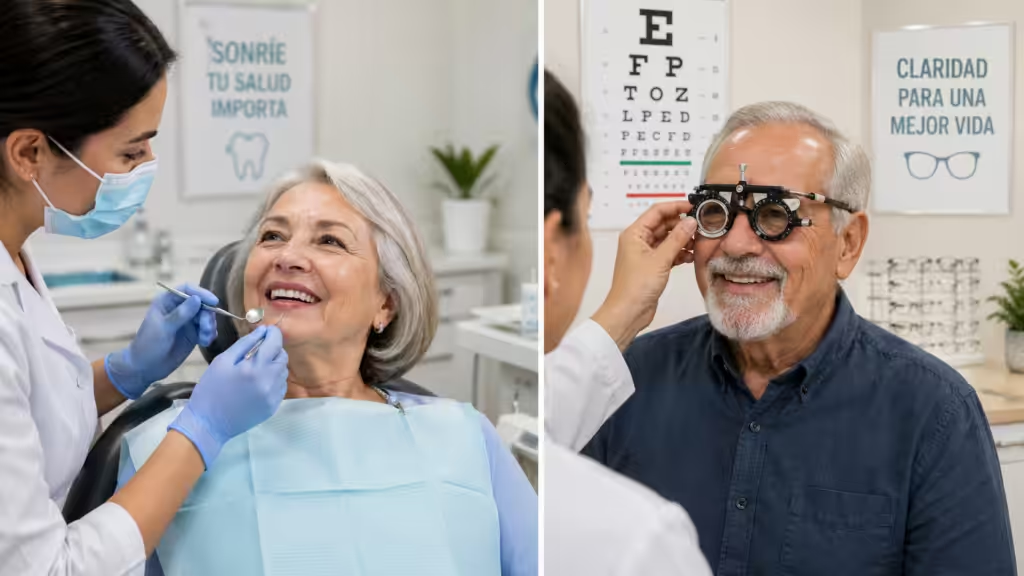
Dental and vision care are two areas where Mexico’s cost advantage shows up immediately in your wallet. Most insurance plans don’t cover routine care in either category, so the out-of-pocket price comparison matters more here than almost anywhere else.
Dental Care
Dental care is one of the most immediate and tangible financial wins retirees discover after moving to Mexico.
Most insurance plans, both US and Mexican, don’t cover routine dental or vision care, which means the out-of-pocket cost comparison matters more here than almost anywhere else in the healthcare picture.
Routine dental cleaning in Mexico typically runs $25 to $50 USD. Fillings cost $40 to $100 USD, depending on the material.
Having a crown fitted runs between $250 and $500 USD, compared to $1,000 to $1,800 USD at a typical US dental office.
Implants, which can cost $3,000 to $5,000 USD per tooth in the US, typically run around $1,650 USD in Mexico.
What About Vision Care?
Routine eye exams are often free, as clinics typically expect patients to purchase prescription glasses and frames from them. However, in some upscale clinics, eye exams can cost between $20 and $40 USD.
Prescription glasses, including frames, frequently cost less than the copay for lenses alone in the US. Major chains like Devlyn, Opticas Lux, and Ben and Frank operate throughout Mexico, and some expats even visit Costco for vision care. In major expat cities, you may also find English-speaking staff, making the experience more accessible for non-Spanish speakers.
How to Navigate a Hospital Visit in Mexico
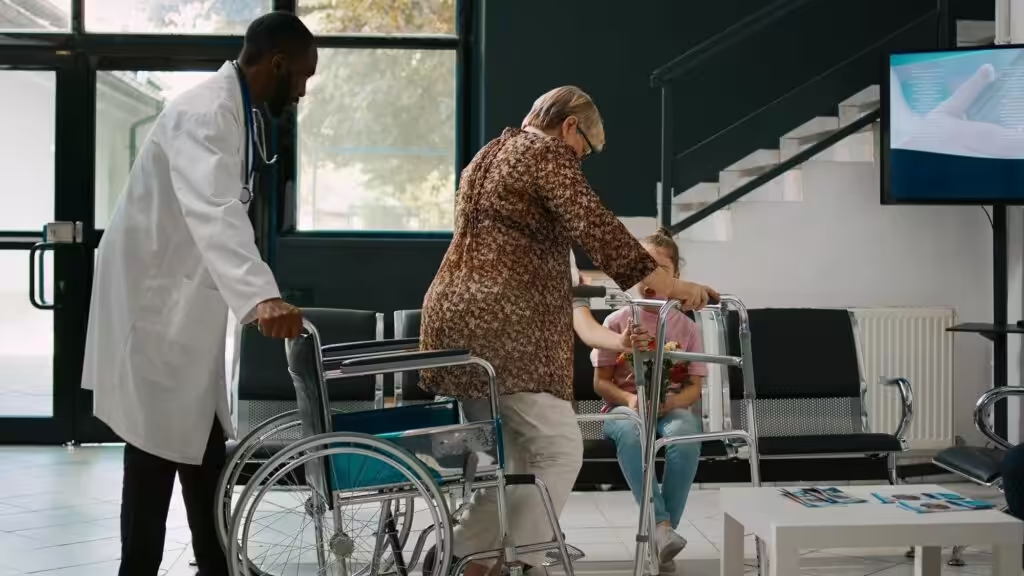
Walking into a hospital in a foreign country is stressful under the best of circumstances. Knowing what to expect before it happens makes the experience significantly more manageable, and in Mexico, a few specific things tend to catch foreign patients off guard.
Private hospitals in Mexico operate very differently from public ones. They offer clear pricing, fast access to specialists without waiting weeks or months, and modern facilities comparable to top private hospitals in the US.
That said, there are practical realities worth understanding before you need emergency services.
Payment and Deposits
Payment comes first in Mexican private hospitals. Many private hospitals in Mexico expect a deposit when you arrive as an emergency patient without insurance.
That deposit can range from 5,000 pesos on the low end to 100,000 pesos or more, roughly $5,000 USD, depending on the treatment needed. More complex procedures can require significantly more upfront. Keep a financial buffer specifically for this purpose.
Retirees who carry private insurance will find that most in-network hospitals waive the deposit requirement, which is one of the less obvious but genuinely useful benefits of having a plan in place before you need it.
Language
In large expat hubs, English-speaking doctors are common in private hospitals. Outside major cities, language access decreases.
If you’re in a smaller town and need hospital care, having a Spanish-speaking friend, neighbor, or local contact who can accompany you is genuinely valuable. Many expat communities have informal networks specifically for this purpose.
There are some handy tools that can make communication easier. Google Translate works well for simple conversations, but for anything more serious like medical explanations or treatment details, specialized medical translation apps tend to do a better job.
A local patient advocate, available in most major expat cities, can accompany you to appointments and ensure nothing important gets lost in translation.
What Should You Bring to a Hospital Visit?
Bring your passport, your resident card, your insurance documents if you have them, and a list of your current medications including dosages.
Private hospitals in Mexico are efficient, but they need complete information to treat you well. Having everything organized in a single folder, physical or digital, saves time and reduces stress when it matters most.
Medical Evacuation

Medical evacuation is the process of transporting you to receive specialized medical care when local facilities can’t provide it. It can involve air or ground transport and is critical in emergencies.
Many retirees assume medical evacuation is included in standard health insurance, but it’s actually separate coverage that requires a dedicated policy. It only pays for transport back to your home country when local treatment isn’t available, and costs can be high without the right coverage.
A medevac flight can cost anywhere from $15,000 to $100,000 USD, depending on distance, aircraft type, and medical crew requirements. Without a dedicated policy, that cost falls entirely on you.
When Does Medical Evacuation Actually Matter?
Mexico’s private hospitals in major cities handle complex procedures well and are equipped for serious medical events. In those locations, evacuation is rarely necessary.
However, the calculus changes significantly in smaller towns, rural communities, and coastal areas where specialized care isn’t available locally. A retiree recovering from a stroke in Puerto Peñasco or San Carlos faces a very different set of options than one in Mexico City or Guadalajara.
Medical evacuation coverage matters most for retirees in these smaller cities, those with serious pre-existing conditions, and anyone whose family strongly prefers that major treatment happen back home. If any of those apply, a dedicated evacuation policy is worth the cost.
And if you do require medical evacuation, you may have heard of SkyMed.
What Is SkyMed and How Does It Work?
SkyMed is one of the most widely used medical evacuation services among North American retirees in Mexico. It provides air transport back to the US or Canada, coordinates with local hospitals, and handles the logistics of getting you home when your condition requires it.
Annual membership plans start at a few hundred dollars per year, which makes it one of the more affordable additions to a retiree’s healthcare planning toolkit.
Other providers worth comparing include Medjet and Global Rescue, each with slightly different coverage structures and service models. Reading the fine print on what triggers a covered evacuation, and what doesn’t, is essential before choosing a plan.
What to Sort Out Before You Move
The retirees who have the smoothest healthcare experiences in Mexico are always the ones who planned before they left their home country, not after they arrived. A handful of practical steps taken in advance make a significant difference.
1. Medical Records and Prescriptions

Bring complete medical records, including recent lab work, imaging, and specialist notes. Mexico’s private healthcare providers are competent and well-trained, but they work best with a full picture of your history.
Having records translated into Spanish is helpful but not strictly necessary in most private facilities in major cities.
Sort out your prescriptions before you leave. Most medications are available in Mexico, and many don’t require a prescription.
Controlled substances are the exception and require more paperwork. If you rely on controlled substances regularly, arrive with an adequate supply and sort out the local prescription process early, before you run out.
2. Specialists and Relationships
Establish a relationship with at least one local doctor before you need one urgently. This allows you to book telemedicine consultations with Mexican specialists before you move, so you can arrive with a primary care provider already in place.
If you have a chronic condition, speak with a specialist in Mexico before committing to a city. They can advise which cities have the best doctors for your specific needs and provide the Mexican equivalent of the medications you’ll require.
That conversation, done before you move, saves considerable time and anxiety once you’re on the ground.
3. Insurance and Financial Planning
Finalize your insurance decisions before you arrive, not in the first few weeks after. Decide whether IMSS enrollment makes sense for your situation, choose a private GMM plan if you want catastrophic coverage, and consider a medical evacuation membership if your location or health profile warrants it.
A reasonable monthly healthcare budget for a healthy retiree in their 60s in Mexico falls between $100 and $300 USD per month, excluding major surgery events. Build your plan around that baseline and adjust from there.
In the End
Eventually, we can sum up everything by saying that healthcare in Mexico is adequate enough to retire without worrying. All you have to do is have the right expectations and prepare ahead of time before you set foot in the country.
Healthcare in Mexico isn’t a compromise. It’s a genuinely different system. Yes, it may not have that private health insurance you’re used to back home, but it still delivers high-quality private care at a fraction of what Americans and Canadians pay.
All you have to do is ask the right questions at the right facilities, and if you need help with that, too, consider utilizing our services.
Find Senior Living Options Across Mexico →